Vigàta Police Department
The Shape of WaterThe Vigàta Police Department is the local force that takes up the investigation after two garbage collectors discover Silvio Luparello’s body. Its place in the story is defined by a contrast: the department has few officers and faces routine operational problems, yet Inspector Salvo Montalbano turns its modest resources toward a close examination of evidence that others might prefer to leave undisturbed.
Local Headquarters and Personnel
The garbage collectors head to the police headquarters rather than the Italian Carabinieri because they know the latter are under a Milanese lieutenant’s command. The local inspector, Montalbano, is from Catania and, in their estimation, is the one who will get to the bottom of things. Their choice gives the department an immediate local identity: its authority rests here not only on its formal role but on the reputation of the investigator who leads it.
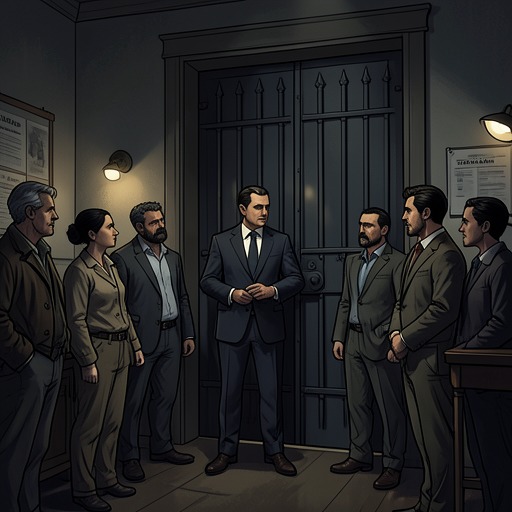
The headquarters is sparsely occupied when Montalbano brings the men in. Apart from Sergeant Fazio, only three policemen are present; the rest have gone to deal with a clothing-shop owner who shot his sister over an inheritance dispute and fled. The empty places at the station register the pressure of simultaneous cases. Montalbano leaves the garbage collectors in the interrogation room, where they sit pale and huddled together, resigned to the long wait they associate with any encounter with the law.
Investigative Work and Coordination
Montalbano’s handling of the Luparello case moves between headquarters and the scene. When he reaches the Pasture, a team from the Montelusa Crime Lab is already examining the ground around the car, walking in circles as they search for clues, traces, and footprints. The department’s investigation therefore includes coordination with a separate forensic team, while Montalbano remains closely involved in interpreting what the physical scene can and cannot establish.
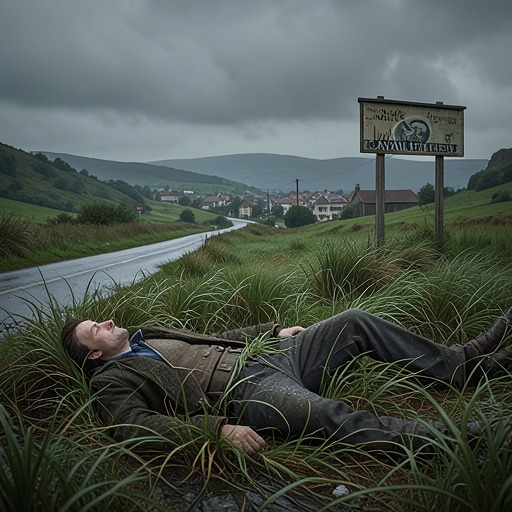
At the car, the inspector confronts the disordered state of a man known for meticulous grooming: Luparello’s tie is missing, his glasses sit askew, and his trousers and shirt have been pulled out of place. The body’s condition prompts questions about how he died and about what happened before he was found. Later, Montalbano returns to headquarters to consult the garbage collectors’ depositions, copies their addresses, and considers whether they may have heard anything about a missing necklace. The inquiry thus develops through ordinary police tasks—questioning witnesses, revisiting statements, and following up on addresses—rather than through a single decisive revelation.
His inquiries also take him beyond the station. In Rabàto, he visits Fatma Ben Gallud, known as Carmen, identifies himself as police, and asks whether anyone at the Pasture had questioned her about finding something. His approach is personal and direct: he tells her to answer truthfully and says he will leave once she does. The scene shows Montalbano using his office to pursue a specific lead, while the evidence comes from conversations with people whose circumstances differ sharply from those of the powerful figures surrounding Luparello.
Publicity, Resources, and Institutional Limits
The department’s handling of publicity is deliberate. At the scene, Montalbano asks whether anyone has called the newspapers; his men have not, and he confirms that he does not want newsmen there. The choice keeps the press away from the early investigation, even as Luparello’s death is attracting extensive public attention elsewhere. Montalbano’s control of information is presented as a practical decision made by the investigator, not as evidence of a broad departmental communications system.
The station’s limited capacity is matched by everyday operational strain. Montalbano angrily rebukes his men because the department’s tyres are repeatedly cut and they have failed to check them before setting out. On one trip, changing a tyre costs them around ten minutes, and the crime-lab team has arrived at the Pasture before they do. The delay is concrete and small-scale, but it makes the department’s constraints part of the investigation’s texture: police work depends on routine maintenance as well as deduction.
Role in the Investigation
The department provides the institutional setting for Montalbano’s work, but the story does not portray it as an all-knowing or fully coordinated machine. Its officers are stretched across cases; witnesses wait; equipment and procedures can fail; and the inspector chooses what information to release. At the same time, headquarters gives the inquiry continuity, from the first questioning of the garbage collectors to the review of their depositions and the return of a newly recognized neck brace from the abandoned factory.
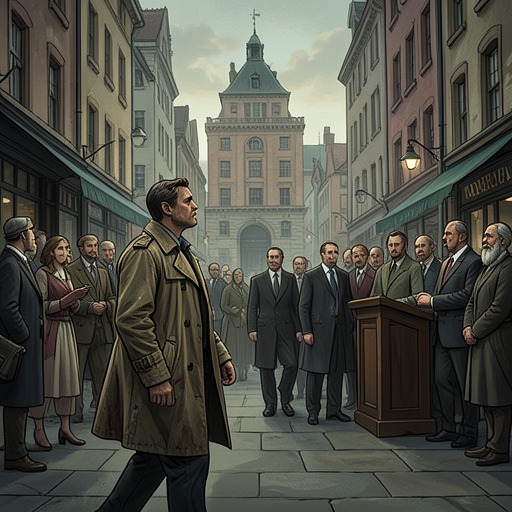
That combination makes the Vigàta Police Department significant to the case’s method. The discovery of Luparello’s body invites a public account shaped by status and ceremony, while the local investigation proceeds through awkward details: clothing out of place, a missing tie, a witness’s uncertain recollection, and objects found among factory debris. The department is the working ground on which those details can be connected, though the decisive scrutiny belongs to Montalbano.